Not much to say today because I have just deleted all the photos I took today and am gutted.
We set off just before 9am intending to arrive at Vicars Hall Bridge on the Bridgewater Canal around noon when it was due to be opened. After three months closure we expected there to be a queue of boats waiting to go north to Liverpool or to escape south. As it happened the canal was opened yesterday afternoon so when we arrived spot on noon there were no boats. In fact we saw only four boats in four hours this morning. I know that those of you south of Anderton don't believe this but since Sunday we have seen no other boats traveling. The custom of waiting in a broad lock for another boat to share it would result in boaters starving to death up here.
So there you have it. The lovely picture of Gecko cruising through the (unfinished) bridge portals on the stroke of noon is not to see the light of day. And I can't start to tell you about the other more wonderful photographs I took.
We have moored this evening near Dunham Masseyr with Anderton our target for tomorrow.
23 miles / 0 locks
Wednesday, 24 May 2017

Tuesday, 23 May 2017
Welcoming New Readers
Today we were overrun by a lovely crowd of youngsters with enquiring minds.
We don't know their names but are sure they will become regular readers of this blog

Best wishes guys with your end-of-year exams
The Road to Wigan Pier
Up early today. Filled up with water and emptied the toilet and set off on the dot of 7am.

Soon after setting off we passed the entrance to the Rufford Arm which links the L&L main line to the River Ribble. This has become popular since the millennium link near Preston made it possible to cross the River and travel up the Lancaster Canal.

At Glovers swing bridge a C&RT working boat was hogging the bridge landing so M had to cross their boat to get to the tow path.
Long before the L&L was built the Wigan coalfields were already using water transport to move their product.
The Little River Douglas was partly canalised through to the River Ribble at Preston .
Along this stretch we passed three of the old locks dating from the early 17th century
From Preston, coal was taken along the coast to Fleetwood, Lancaster and Liverpool .
When the L&L was finally finished over a hundred years later the Douglas link became redundant.
During the second World War the strategic importance of the L&L was recognised as was its vulnerability. Along its route pillboxes were built and manned by the Home Guard (aka Dad's Army) much as the Kennet & Avon Canal was defended

And we must not forget that coal was not the only commodity carried along this canal.
Grain, and, of course, flour were regularly moved.
This old windmill near Parbold is right alongside the canal.
On arriving at Wigan we made two attempts to moor. Our first choice was too shallow and so we moved over to the ex BW bollards. Here we were more successful until a pair of boats went down the lock we developed a significant list.

So we left Wigan centre and found a lovely spot alongside Scotman's Flash.
13.5miles / 8 locks / 2 swing bridges

Soon after setting off we passed the entrance to the Rufford Arm which links the L&L main line to the River Ribble. This has become popular since the millennium link near Preston made it possible to cross the River and travel up the Lancaster Canal.

At Glovers swing bridge a C&RT working boat was hogging the bridge landing so M had to cross their boat to get to the tow path.
 |
| The old lock at Appley Bridge |
Long before the L&L was built the Wigan coalfields were already using water transport to move their product.
The Little River Douglas was partly canalised through to the River Ribble at Preston .
Along this stretch we passed three of the old locks dating from the early 17th century
 |
| The Little River Douglas flows to the right of the L&L lock |
From Preston, coal was taken along the coast to Fleetwood, Lancaster and Liverpool .
When the L&L was finally finished over a hundred years later the Douglas link became redundant.
 |
| Pillbox near Parbold |
During the second World War the strategic importance of the L&L was recognised as was its vulnerability. Along its route pillboxes were built and manned by the Home Guard (aka Dad's Army) much as the Kennet & Avon Canal was defended

And we must not forget that coal was not the only commodity carried along this canal.
Grain, and, of course, flour were regularly moved.
This old windmill near Parbold is right alongside the canal.
On arriving at Wigan we made two attempts to moor. Our first choice was too shallow and so we moved over to the ex BW bollards. Here we were more successful until a pair of boats went down the lock we developed a significant list.

So we left Wigan centre and found a lovely spot alongside Scotman's Flash.
13.5miles / 8 locks / 2 swing bridges
Monday, 22 May 2017
Dale Street
Today I had to go into both Southport and Manchester by train so I was able to not use the transport interchange at Burscough Bridge. With no ticket office at the station I endeavoured to buy the tickets for this excursion on the train but by the time the ticket man reached me the train had reached Southport so I bought them at that station.
My meeting in Manchester was in Dale Street. Some of you might remember stopping here on the Cheshire Ring to buy the license to descend the Rochdale Nine from a little hut in the car park.
After my meeting, therefore, I walked down to the bottom of the street, where it meets Dulcie St.

My train had brought me into Victoria Station and as I made my way I spied this pub with he odd name:
The Lower Turk's Head
I wonder how that name came about.
What indeed is a lower Turk's head?
There is still a car park at the junction of Dale St and Dulcie St but the area does not have the aura it had in the 1970s. I always found it a little foreboding, like buying a ticket for hell.
The start of the Rochdale Nine always seemed to be cloaked in dark mists and shadows but perhaps my memory is playing tricks on me.
And the Ashton Canal seemed never seemed any more inviting.
My meeting in Manchester was in Dale Street. Some of you might remember stopping here on the Cheshire Ring to buy the license to descend the Rochdale Nine from a little hut in the car park.
After my meeting, therefore, I walked down to the bottom of the street, where it meets Dulcie St.

My train had brought me into Victoria Station and as I made my way I spied this pub with he odd name:
The Lower Turk's Head
I wonder how that name came about.
What indeed is a lower Turk's head?
 |
| Starting the Rochdale Nine in 2017 |
There is still a car park at the junction of Dale St and Dulcie St but the area does not have the aura it had in the 1970s. I always found it a little foreboding, like buying a ticket for hell.
The start of the Rochdale Nine always seemed to be cloaked in dark mists and shadows but perhaps my memory is playing tricks on me.
 |
| Entrance to the Ashton & Peak Forest Canals in 2017 |
And the Ashton Canal seemed never seemed any more inviting.
Sunday, 21 May 2017
We're Off !
After two years of neglect, Gecko is off again.
 At 2.30pm on the dot we slipped our moorings and battled our way out of Scarisbrick Marina . The wind direction prevented us heading directly for the exit so we reversed to the point where we could spin round and dash for the exit bridge.
We are only going three miles to Burscough Bridge as I have to take a train to Southport and to Manchester tomorrow . It took us an hour and forty minutes to cover this short stretch of the L&L canal as we had two swing bridges to operate.

The first, at the Farmers' Arms was a busy road which is always fun to see the queue of cars building up as we make our sedate passage. It might have been easier had there not been a plastic boat moored on the bridge landing.
The second is also by a pub. When we passed this way relocating Gecko from Anderton to Scarisbrick last May, the bridge mechanism failed and we had to wait for the engineer to come out and fix it. No such problems today but the Slipway pub is now all boarded up.
 We moored just before the long term moorings so that we can call at the water point and Elsan on Tuesday as we head off towards Wigan.
Just to be sure the station had not closed down in the past year or so, I walked down to the railway bridge.
A few years ago a lovely transport interchange was built here with a cafe and ticket office.

And it's right behind the Bridge Inn. How convenient.

Well, there USED to be a cafe and ticket office, also a toilet and bike store.
At least the trains still call here
4 miles / 0 locks

We are only going three miles to Burscough Bridge as I have to take a train to Southport and to Manchester tomorrow . It took us an hour and forty minutes to cover this short stretch of the L&L canal as we had two swing bridges to operate.

The first, at the Farmers' Arms was a busy road which is always fun to see the queue of cars building up as we make our sedate passage. It might have been easier had there not been a plastic boat moored on the bridge landing.
 |
| Guess why it's called The Slipway |

Just to be sure the station had not closed down in the past year or so, I walked down to the railway bridge.
A few years ago a lovely transport interchange was built here with a cafe and ticket office.

And it's right behind the Bridge Inn. How convenient.
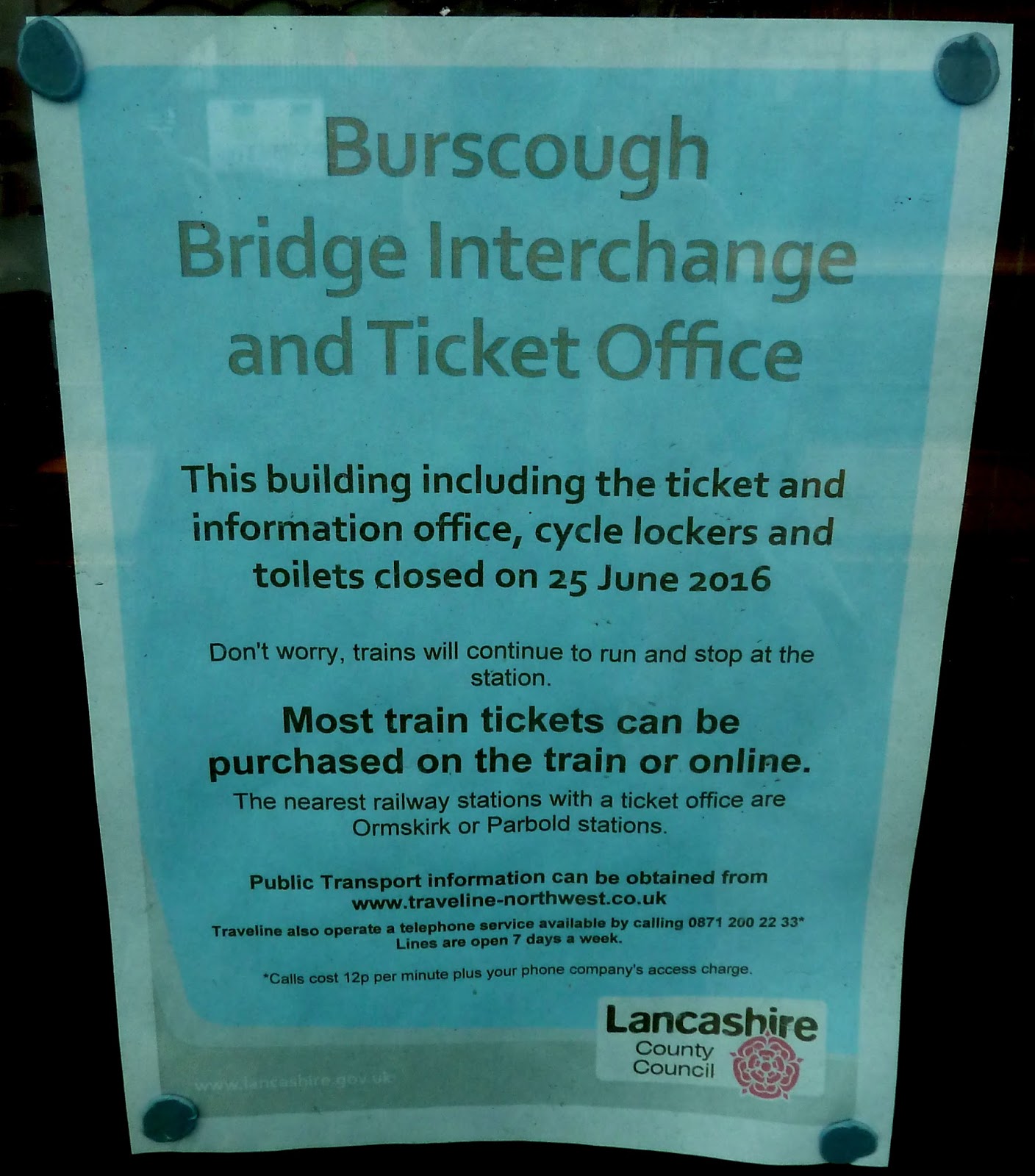
Well, there USED to be a cafe and ticket office, also a toilet and bike store.
At least the trains still call here
4 miles / 0 locks
Saturday, 20 May 2017
Josephine Baker Day

designated May 20
Josephine Baker Day


Very soon after I started writing this post I ran into a problem I often have - how do I do justice to the subject without boring everyone. So much has been written by so many people and so much better than I could achieve that I have decided to direct you to some of that material rather than trying to distill it for your consumption.

I first became aware of Josephine Baker and the place she has in the hearts of the French when I worked in Paris. Our office was in Neuilly and we often (too often by British standards) repaired to the local café which was named after one of her most famous songs - J'ai Deux Amours
See her perform it here - J'ai deux amours

Baker is most widely known for her erotic and humourous dancing and singing and, in particular, for her Banana Dance where she wore nothing but a skirt comprising sixteen (artificial) bananas. The film clips of this all come from performances in USA where she wore more garments for local taste.
But this clip will give you an idea of her humour - Don't Touch Me Tomatoes
La Baker, as the French called her, was more than just a singer and dancer.
This article entitled Dancer, Singer, Activist, Spy goes a long way to explaining this.
But Josephine Baker was more than just a Dancer, Singer, Activist & Spy
Growing up in USA she encountered ingrained racial prejudice which contrasted to her reception in France. Here the public took her into their hearts - granted her citizenship and awarded her gallantry medals for her resistance work. When she died in 1975 she was buried with full military honours - 21 gun salute included - by her adopted homeland, France.
Throughout her life she fought against prejudice which came from her belief that all people should, and could, live in harmony . She did not agree with the Melting Pot philosophy of racial integration. She believed all cultures must be celebrated for their diversity and by living by this doctrine the world would be a more peaceful and happier place.
Her approach to demonstrating this was revolutionary : initially lauded but later considered an unfortunate mistake.
In 1953 she embarked on a programme which resulted in her adopting, sometimes under dubious circumstances, twelve children from diverse cultures and raising them as cultural stereotypes. She is quoted as saying:
I will make every effort so that each shows the utmost respect for the opinion and beliefs of the other. I want to show people of colour that not all whites are cruel and mean. I will prove that human beings can respect each other if given the chance.
Her adoptees included Akio (Korean), Teruya (Japanese), Jarry (Norwegian) and Luis (Colombian). Unable to obtain a child from Israel she adopted a French boy and brought him us as a Jew. Marianne and Brahim from Algeria she decided were Catholic and Muslim respectively. Others were brought from Ivory Coast, Venezuela and Morrocco. All were brought to her Chateau des Milandes in Perigord which was developed as a theme park featuring the children as hosts.
 |
| Chateau des Milandes during restoration |
 |
| Chateau des Milandes as restored in 2016 |
 |
| Chateau des Milandes restored |
Josephine Baker may have been misguided in the exercise of her quest for mutual respect across all cultures but I respect her for the strength of her belief and the commitment to try to achieve it.
And I enjoy her singing
And I enjoy her singing
Monday, 15 May 2017
How Nestle Hides Price Rises
 |
| NEW RECIPE - 8 sachets to a box |
Nestle have been advertising their
"New Recipe"
Instant Cappuccino recently
(When was anything not
NEW and/or IMPROVED??)
 |
| 10 Sachets but no sprinkles |
Last week there were
10 sachets in a box.
Now there are 8,
Now there are 8,
That's 20% less


Originally each carton included a little plastic tube of chocolate sprinkles
Where did they go?
Sneaky , aren't they?
Friday, 21 April 2017
How the EU complicates life
How many beans?

What do you expect the contents of this can of beans to weigh?
390g?
Don't be silly - we're still in the EU!
Before we joined the Common Market/EEC/EU every can of beans had to contain at lest the declared weight. Manufactures would aim for 16oz but declare 15.5oz.
Consumers knew that if they tipped the beans out and they weighed less than 15.5oz they had been cheated.
Trading Standards knew that if they tipped the beans out and they weighed less than 15.5oz the consumer had been cheated
Manufacturers knew that if they checked a sample from each production batch they could be sure they were not cheating anyone.
Life was simple wasn't it?
Then we joined the Common Market and the introduction of this symbol.
With this came:
Processing variations,
standard deviations,
negative tolerances,
sampling allowances,
wandering averages,
storage allowances,
fill temperature allowances
and action limits
The situation now is:
Consumers have no way of knowing whether they are being cheated or not
Trading Standards have a monumental task if they want to check whether a manufacturer is complying with weights and measures regulations.
Manufacturers have to maintain extensive and complicated records for Trading Standards to audit.
If you are interested in the details then peruse the example given below in the guide to the legislation. (This is for sweets and may be a little more complicated than for canned beans)
An
example on setting target quantities and action limits
SCENARIO
A
packer produces 200 g bags of sweets; the variation due to the
packing process is dependent on the size of sweet.
The
process variation, stated as a standard deviation, is either 4 g, 5 g
or 6 g.
The
packing line produces 4,000 bags an hour and the packer monitors the
average
weight
of the product by taking samples of five bags from the line every 30
minutes.
The
average of each sample is calculated and used to determine when
action is needed.
What
should be the lowest target quantity the packer should aim for, and
what should
the
minimum action limit (1 in 1,000) for the sample mean be, for each of
the three processes?
CALCULATION
1.
Lowest
Target Quantity
1.1. Process
variation
1.1.1. The
average range or standard deviation can be used to consider this
parameter.
The
standard deviation (SD) is more robust, as it is based on all the
data available. In either case, the following assumes that the
distribution of the contents of the packages is ‘normal’. If this
assumption is incorrect the variation from normality also has to be
considered.
1.1.2. In
the scenario the variability of the filling process is given as a
standard deviation. In order to ensure all three packers’ rules are
met, the highest of the following has to be used to address this
variability:
Qn T1+2s T2+3.72s
where
Qn is
the nominal (labelled) quantity
s
is the standard deviation of the filling process,
T1 is
Qn – TNE
T2 is
Qn –2
TNE
TNE is
the tolerable negative error for the nominal quantity
.
WELMEC
document 6.4 at paragraph E2.5 deals with this matter as above. It is
treated differently in the Packers Code at paragraph C15, but the
result is the same.
For
the various process variations the results are:-
Process
variation Qn T1+2s T2+3.72s Largest
4 200 199 196.88 200
5 200 201 200.6 201
6 200 203 204.32 204.32
As
can be seen from this table that which of the packers’ rules is
critical depends on the variability of the filling process. In this
exercise the critical rule is:-
For
s=4 g the first rule, ensuring the average is correct,
For
s=5 g the second rule, ensuring that the number of packages having a
greater negative error than the tolerable negative error
isacceptable, and
For
s=6 g the third rule, ensuring that there are no packages with a
negative error greater than twice the tolerable negative error
produced.
1.1.3. The
above ‘largest’ quantities would be acceptable as a target
quantity if there were no other issues that needed addressing. The
scenario gave information about the sampling plan the packer is using
and so the adequacy of this needs to be considered.
1.2. Sampling
Allowance
1.2.1. Generally
the packer’s sampling plan is considered to be equivalent to the
reference
test if at least 50 items are sample d during the time that 10,000
packs
are
filled (with a minimum time of 1 hour and a maximum time of 1 day or
shift).
See
the Packers Code, paragraph C22, or WELMEC 6.4, paragraph E.3
1.2.2. The
scenario is that the packing line produces 4,000 bags an hour and
the
packer monitors the average weight of the product by taking samples
of five bags
from
the line every 30 minutes. The average of each sample is calculated
and
used
to determine when action is needed.
From
this information, the time taken to fill 10,000 packs, referred to as
the
Production
Period, is equal to 10,000/4,000 hr = 2.5 hr.
The
number of samples (of size 5, i.e. n = 5) taken during this period,
sampling
every
half hour, is k = 2.5/0.5 = 5.
Therefore
the number of items sampled during the
production
period (time taken to produce 10,000 packs) is kn = 5x5 = 25. As this
is less than 50 a sampling
allowance
is needed to ensure that the packers system is as efficient as the
reference
test in detecting non-compliance.
1.2.3. The
appropriate allowance, which is used to enhance the target quantities
established
in 1.1.2 above, is obtained by looking up the tables in the Packers
Code,
Table C1, or WELMEC 6.4, Table E.3.
The
allowances are based on 3 control system:-
-
using
Shewhart Control with Action
Limit
only (1 in 1,000),
-using
Shewhart Control with Warning Limit (1 in 40) & Action Limit (1
in 1,000), and
-using
Cusum control with h=5, f=0.5 (as per BS 5703)
The
exercise indicates that only an Action Limit is used which is
referred to as
Procedure
A in the tables.
1.2.4. Looking
at n=5 and k=5 for procedure A gives a sampling allowance
factor,
z = 0.20. This factor is multiplied with the standard deviation of
the
packing
process to produce an allowance, which is added to the targets
determined
in 1.1.2 above.
1.2.5. The
minimum target quantity taking into account process variability and
sampling
becomes:
Process
SD Qn T1+2s T2+3.72s Largest zs=0.20s Min
Qt
4 200 199 196.88 200 0.8 200.8
5 200 201 200.6 201 1 202
6 200 203 204.32 204.32 1.2 205.52
1.3. Other
Allowances
1.3.1. The
scenario does not give any indications that other allowances are
necessary
but other issues that need to be considered include:-
-a
‘wandering average’,
-storage
allowance, particularly for desiccating products,
-tare
variability, where the quantity determination assumes a constant tare
weight,
-temperature,
if the product is filled hot or cold and the volume changes when
determined
at 200C
Theses
are considered in the Packers Code in paragraphs C21 to C25 and
WELMEC
6.4 in paragraphs E.5.1 to E.5.4.
2. Action
Limits
1.4. The
scenario asks for the ‘minimum action limit (1 in 1,000) for the
sample
mean’. The distribution of the sample mean (of samples of size n)
is
related
to the distribution of the individual items (the process
variability).
1.5. If
the process variability (standard deviation) is s
and
the number of items in a sample is n
then
the standard deviation of the distribution of the means, sometimes
referred to as the standard error of the means, is s/n
1.6. The
action limit, with a chance of 1 in 1,000 of exceeding, as with the
normal
distribution comes at three times the standard error away from the
target
quantity.
Only the lower action limit is needed for legal metrology, although
upper
limits may be set, for example for safety reasons (aerosols), or
economic
reasons
(duty on alcohol) –but
the corresponding limit must be no nearer the
target
quantity than the lower one.
So
for legal metrology the Action Limit should be no lower than Qt -3
s/n
(If
there was a warning limit of 1 in 40 being used this would be at 2
times the
standard
error.).
An
example is given in the Packers’ Code at paragraph C34, it is also
covered in
WELMEC
6.4 at paragraph E.7.2.
Using
the data from the exercise this gives:
RESULTS
Process
Variation,s Minimum Target Quantity (g) Minimum Action Limit forthe
Mean (g)
4
g 200.8 195.4
5
g 202.0 195.3
6
g 205.5 197.5
So that's all clear now!
Thursday, 20 April 2017
Eco Hull
I received an enquiry recently from an anonymous reader who was trying to contact the owner of the Eco Boat which I reported on in April 2011.
Unfortunately no return address was left so a direct reply was not possible.
If you are reading this I would direct you to a website called Boatdesign.net where someone called Richard has made contact with the owner following my blog post.
If you do make contact with Richard perhaps you could remind him to acknowledge me and my blog whence he borrowed the photos .
Unfortunately no return address was left so a direct reply was not possible.
If you are reading this I would direct you to a website called Boatdesign.net where someone called Richard has made contact with the owner following my blog post.
If you do make contact with Richard perhaps you could remind him to acknowledge me and my blog whence he borrowed the photos .
TSB = The Stupid Bank
Whilst we were away in China we received an email from TSB where we had a small savings account. As all Google activities are blocked in China we could not read the email but it was followed fairly swiftly by an SMS. This we could read and learned that there appeared to be a problem with out account. As no activity was anticipated on the account other than the receipt of interest we were a little concerned. The SMS was not specific about the nature of the problem and, as it came from a NO-REPLY address we could not enquire. Unable to contact TSB by email or SMS and with mobile calls costing £1 a minute I eventually made a quick call ensuring that from the outset they had their tape running. I gave them our details and asked them to sort out the problem and let us know the outcome by SMS. Two months later, when we returned to UK, I logged on to our account to find that TSB had been trying to make a payment from an account with 26p in it. Each time they tried they charged us £10. (They never responded to my call) After reading the message from TSB I attempted to respond but the function for this process was greyed out.
So I called TSB and asked why the Respond now function was not available and was informed that this was because it was not available.
So why is it there? I asked
Because it is not available. They responded
So why is it there? I asked again
Because it is not available. They responded again
So where is the Order Coffee button then? I asked

So I called TSB and asked why the Respond now function was not available and was informed that this was because it was not available.
So why is it there? I asked
Because it is not available. They responded
So why is it there? I asked again
Because it is not available. They responded again
So where is the Order Coffee button then? I asked

The account is closed now and the £30 in charges have been cancelled.
I think we will stick to banks where bi-lateral communication is possible.
Subscribe to:
Posts (Atom)