Thursday, 28 October 2010

Wilstone Kingfisher
This post is for two ladies who do not know each other - Margot and Annie - who will appreciate it for different reasons.
At Leighton Buzzard (the home of The Borrowers) we met up with Xilion Rose and Hampshire Rose also on their way to Aylesbury for the winter. As Hampshire Rose was staying longer, we travelled down to Marsworth with Xilion Rose which made the broad locks more enjoyable.
Xilion Rose was built at Severn Valley about a year ofter Gecko but the original owners had to sell it a year or so later. We first met the new owners, Malcolm and Annie, at Dudley Tunnel in the summer when we were all on an IWA boat trip.
As we climbed up into the Chilterns we discovered that the original owners of Xilion Rose had been on the BCN Explorer Cruise last year(see blog entries for August 2009) with us - Elaine and Derek on their shorter boat, Misty. We spent the night at Marsworth Junction in order to descend the Aylesbury Arm as far as Wilstone in the morning.

Last time we came this way we had to wait at the first lock whilst BW fitted a new balance beam to the top gate.


This time we had to wait in the pound below lock 6 when we ran aground due to lack of water.
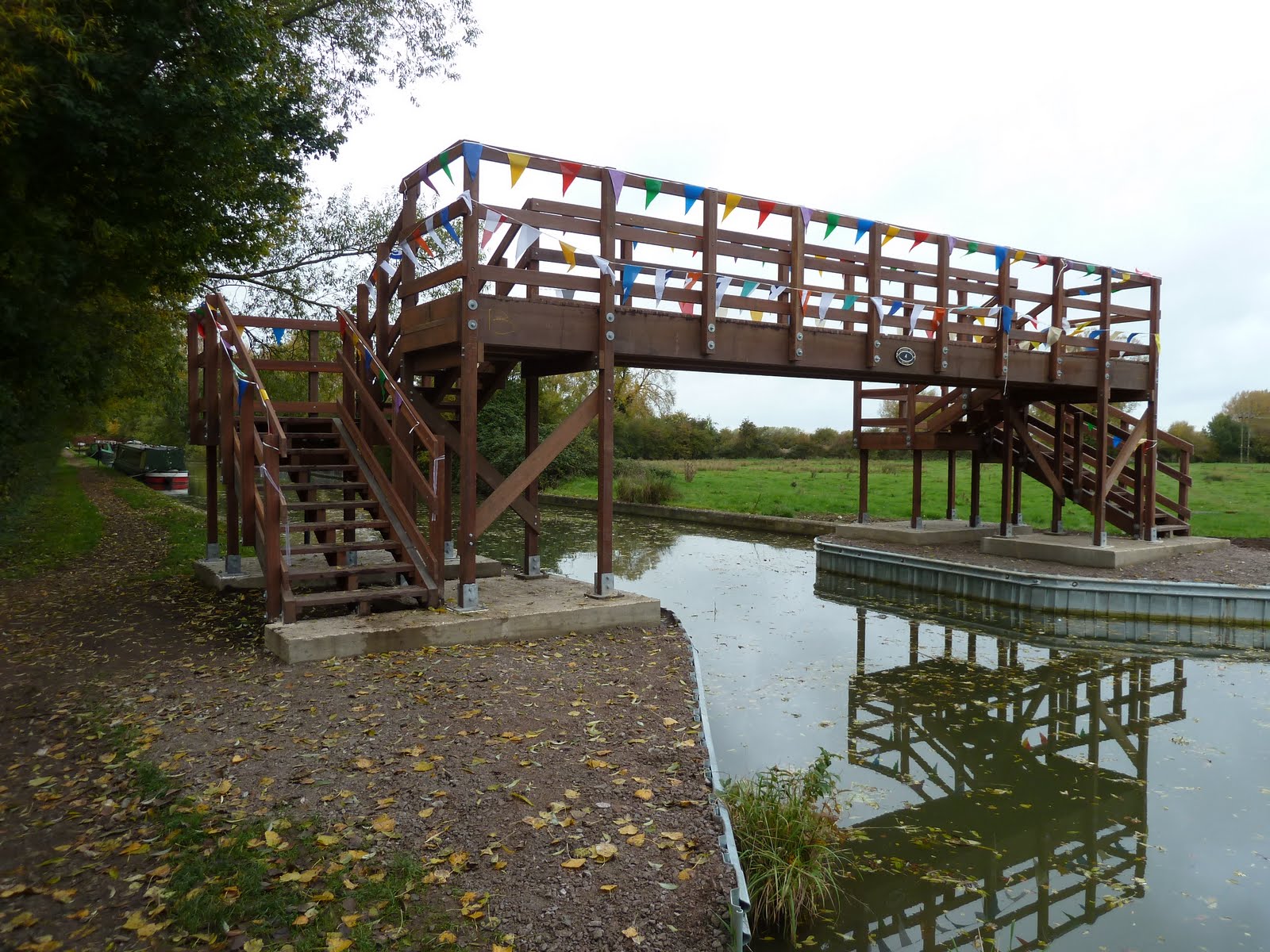
When we arrived at Wilstone we were greeted by a lovely new footbridge complete with bunting. We are quite accustomed to this kind of treatment but nevertheless it is always heartwarming to know that we are appreciated so much. I did wonder, however, if the money to build such a splendid footbridge so that villagers can walk their dogs on the other side of the canal might have been better used to ensure the canal water supply was adequate for the passage of boats.
On our way back to Gecko after picking some damsons she who must be obeyed spied a kingfisher alternately washing and fishing on the opposite bank. Ever the professional, I whipped out my pocket camera and snapped a few shots. As I find these such difficult birds to photograph I am treating you to several of today's crop.


Tuesday, 26 October 2010

Fenny Stratford - Leighton Buzzard
As usual we spent a few days in Fenny Stratford. We always feel comfortable here. Unusually for us, however, we did not visit Bletchley Park this trip. When we passed this way two years ago we made two visits in three days. There really is a lot to see and the ticket is valid for 12 months. It is now open all year, apart from Xmas.
On our last passage through the stop lock Mrs. L slipped when stepping across the gates and ricked her back so afforded it a little more respect this time

This lock has a rise of about a foot and was a cheaper alternative to building an embankment from here to Cosgrove .

Fenny Stratford should be known for the invention of the so-called diesel engine. Henry Akroyd Stuart invented and produced the first working heavy oil engine here in 1890 - two years before Diesel designed his version. An early model was tested in the offices of the local newspaper and the first production model operated in the Great Brickhill Waterworks from 1892-1923.


Before we left the fuel boat came past so we filled up with Akroyd fuel.


Monday was a glorious sunny day although there was an overnight frost. At this time of the year cruising is so leisurely: we met only one boat in five hours.


In the last 80 years Leighton Buzzard lock has lost its impressive steps and its working boat traffic. -see comments about this bit of twoddle


We moored up just after the Tesco 2 hour shopping slot. Yes - we have them on the canals too!

Monday, 25 October 2010

WADIHS
Posts relating to the recent trip to Grimsby can be found below on these dates:
October 25, 23, 16, 14, 6
A Boat Too Far?
The Ross Tiger was the first of the Cat class trawlers to be built for Ross Fisheries.


The twelve boats were :
Ross Tiger, February 1957
Ross Leopard, October 1957
Ross Jaguar, December 1957
Ross Panther, April 1958
Ross Cougar, April 1958
Ross Cheetah, November 1959
Ross Lynx, February 1960
Ross Jackal, April 1960
Ross Puma, August 1960
Ross Genet, October 1960
Ross Civet, October 1960
Ross Zebra, !?!? November 1960
After her retirement she was given to N.E.Lincs Council for £1 and is moored in Alexandra Dock, Grimsby next to the Fishing Museum. Guided tours are given by ex-trawler men who worked on the ship so are entertaining as well as informative.
A little further along the dock Lincoln Castle is being broken up due, in part, to the local authority's attitude regarding possible preservation. The owner has decided to sell it for scrap. To read more about the unnecessary demise of Lincoln Castle click here.
If, like me, this makes you want to go out and kick someone then read on.
Alongside the Ross Tiger in Grimsby lie the remains of the oldest registered fishing vessel in the world.

Sold at auction on 4 May 1888, this Grimsby sailing smack was launched on 15 June 1888 and named G.I.C.
With a crew of two men and three boys she fished for the Grimsby Ice Co. Ltd. until April 1896, when she was sold to Great Yarmouth.

In 1902 she was sold to Iceland and renamed ESTHER. Twenty years later she was sold on to the Faeroe Islands, where she remained for the next seventy years.

Sold back to Grimsby in 1992, she was incorporated into the historic fishing fleet of the National Fishing Heritage Centre where she now sits and rots. No doubt she will soon share the same fate of Lincoln Castle.
Still not worked up enough? Then read on.
Friends of ours who have lived on their narrowboat on BW moorings for the at least six years have recently given up the mooring. Gordon, Becky and their children have been putting up with the dust and noise created by developers building flats alongside their mooring over the past two years. The flats are now occupied and one of the residents threatened Gordon because "Ive had three months looking at your boat" There used to be four boats all paying £2000+ p.a. to BW along this stretch of canal.Now there are just morons behind the hedge.
Now go out and kick someone!

Saturday, 23 October 2010

A Bridge Too Far?
Span Information
In October 1964 Harold Wilson and the Labour Party won the General Election with an overall majority of four seats. This proved to be even more unworkable when over the next two years this majority was reduced to two seats. In an effort to save his government in 1966 he persuaded Barbara Castle the then Minister of Transport to 'bribe' the electorate of Hull North by promising to finance the building of the Humber Bridge. The by-election was duly won as was the hastily organised General Election which followed.
The Humber Bridge opened to traffic in 1981 but the idea of a bridge over the estuary goes back much earlier than that.


MV Lincoln Castle operating the ferry service between Hull and the north Lincolnshire coast which had started in 1820.


After many years of neglect Lincoln Castle was being broken up in Grimsby when we visited a few weeks ago.


Construction of the bridge commenced in 1973 and proved challenging from the start. The geology of the area, particularly on the south bank, caused lengthy and costly delays, as did strikes and bad weather. The foundations for the south tower, which is set into the river bed, had to be 36 metres deep whilst those of the land-based north tower are only 9 metres deep.
The suspension design was developed from the Severn Bridge and has a design lifespan of 120 years. Consulting engineers for the project were Freeman, Fox & Partners.


Some interesting statistics:-

The main cable is 2ft3ins in diameter.

Over 44,000miles of wire are used in the cables.

27,000 tons of steel and 480,000 tons of concrete


A little further up the Humber is South Ferriby Sluice where the New River Ancholme drains into the Humber. This drainage scheme was first constructed in the 18th century but 50 years later Sir John Rennie proposed to straighten and widen the drainage canals replacing the multi spanned bridges by single span ones.
At Horkstow he built one of the earliest examples of a suspension bridge. At 140ft long and 14ft wide this cast iron and timber construction is somewhat smaller than Barara Castle's bridge just up the river but no less elegant.
I believe this is the only suspension bridge built by Rennie and is rather grand for an accommodation bridge.
The iron was cast at Gospel Oak Ironworks in Tipton, Staffs. and the bridge was completed in 1836, 150 years before the Freeman, Fox and Partners design. I wonder what lifespan he predicted for it!

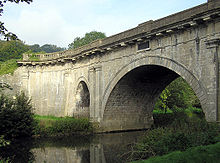
Rennie is probably better known for his work on the Kennet & Avon Canal such as the Dundas Aqueduct

Thursday, 21 October 2010

Sally-Ann's Autumn
With fewer boats around than usual, we managed to moor close to the Waterways Museum at Stoke Bruerne hoping that there would be a boat to share the locks with in the mooring.
No such luck. The only other boat was a Wyvern hire boat facing the other way. Passing the time of day with the hirers who hailed from Tasmania it transpired they had decided not to tackle Blisworth tunnel. In order to return their boat on time they would have to turn round and return immediately and two passages of a dark and wet tunnel was not particularly attractive to them. Luck had changed - we now had someone to share the locks - with seven crew members - what a bonus!
As we approached Cosgrove where we intended to moor we were discussing Robin and Carole who used to live on nb Inanda and moored by the Barley Mow in Cosgrove. They sold the boat soon after travelling up the Thames to Lechlade with us and now live in a house. Mrs L was musing that we had not seen Inanda around since the change of ownership. I was only listening with half an ear as my attention was concentrated on avoiding a boat coming through the beautiful bridge at the beginning of the village . As it passed we realised it was in fact Inanda with the new owners.
We moored above the cattle creep which now has a sign post describing it as a horse tunnel. I do not know if there is any evidence of it being built for horses or whether the local authority decided to dumb down the description. I recall this featuring on the front cover of Devil in the Detail, one of the murder mystery stories set on the Grand Union written by Leo McNeir
If you decide to read these books I recommend that you do so in chronological order starting with Sally Ann's Summer.

Central to these stories is the narrowboat Sally-Ann.
Moored just across from us, by the old brewery, is none other than the star of these books looking just as she is depicted in the books. About time she was freshened up, Mr. McNeir
A Touch of Frost
Woke this morning to the first frost of the season. Emerged from under the tonneau to find Gecko crusted with white frosting. On our way to Wolverton received a text message announcing the arrival of a daughter to friends who live in Fenny Stratford. Wonderful news so had to stop to shop by the new flats on the site of the Wolverton Rail Carriage Works. Hopefully we will still have time to drop into the Rohan outlet shop at Giffard Park before we moor at Peartree tonight for a carvery.

Monday, 18 October 2010

Libel
It has been pointed out that, contrary to my report yesterday, Corona and Victoria did in fact join the Jam 'Ole Run at Atherstone. The reporter responsible has been disciplined and I apologise for any embarrassment her dodgy information may have caused.

Sunday, 17 October 2010

Jam 'Ole Run 2010
Every October a group of ex working boats re-enact the coal run from Atherstone to the Kearley and Tonge jam factory in Southall.


From here


To here


We moored at Norton Junction to let them pass. The first three came by fairly promptly.


Victoria


Corona


Stanton


But then we had a long wait for the other half. When they did turn up we learned that a cow had jumped into the cut in front of Renfrew near Barby and it had taken an hour to get it back on dry land.


Renfrew


Dove


Archimedes


But we can reveal here that Corona and Victoria did not start at Atherstone, they only joined the run at Braunston.

Saturday, 16 October 2010

The Deserts of Lincolnshire
Question: If you own a defunct tileworks and need a wall around your yard what do you do?
Answer: Build a wall with the tiles you can't sell.

This is on the banks of the Humber not far from Barbara Castle's bridge.


Question: If you have an 1890 G.E. Railway carriage and no railway, what do you do with it?
Answer: Sell fruit from it for 60 years and then set up a tea shop.


Curent resting place is alongside the six-sail post mill at Waltham near Grimsby.


Question:
What do you call it when you have sold out of everything but jelly and ice cream?
Answer: A Desert